The JUKI TL-2010Q
Introduction
The JUKI TL-2010Q is a very different proposition from the typical computerized home sewing machine. Instead of offering hundreds of decorative stitches, embroidery functions, or a large LCD interface, JUKI has designed this machine around one purpose: producing fast, precise and consistent straight stitches.
It is a semi-professional, single-needle lockstitch machine aimed particularly at quilting, piecing, tailoring, apparel and home décor. Its industrial-inspired aluminum construction, 1,500 stitches-per-minute maximum speed, large sewing area, automatic thread trimming and adjustable presser-foot pressure make it an interesting choice for experienced home sewists.
For anyone comparing sewing machines for serious quilting or heavier sewing, the TL-2010Q deserves attention because it combines several characteristics normally associated with industrial equipment with the convenience of a portable domestic machine.
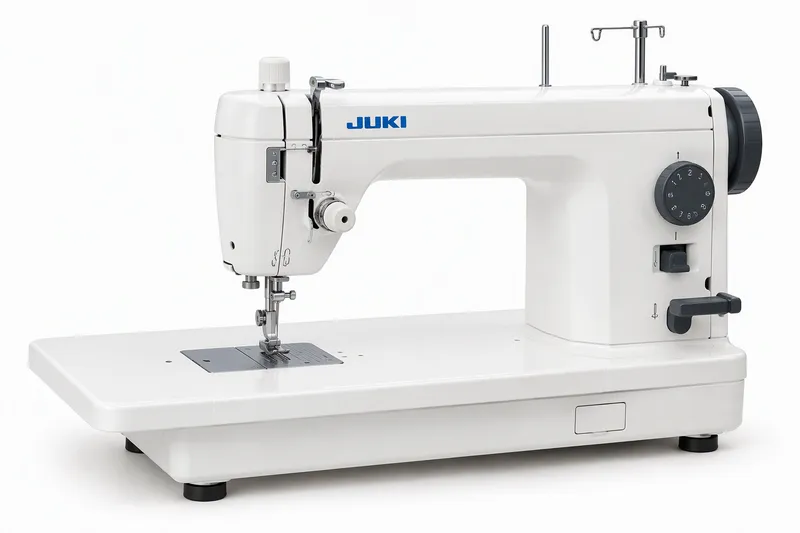
JUKI TL-2010Q
A powerful, high-speed straight-stitch sewing machine designed for precise sewing, quilting, and demanding projects. Its sturdy construction and consistent stitch quality make it a great choice for experienced sewists working with multiple fabric layers, denim, and canvas.
Who is this machine for?
The JUKI TL-2010Q is primarily intended for intermediate and advanced sewists, particularly those who spend a lot of time quilting, piecing, making garments, sewing home décor or working with multiple layers of fabric.
It can also be an excellent upgrade for an experienced beginner who already knows that straight-stitch sewing is the main type of work they want to perform. The controls are actually relatively straightforward because there is no complicated computerized menu or large collection of stitch patterns to navigate.
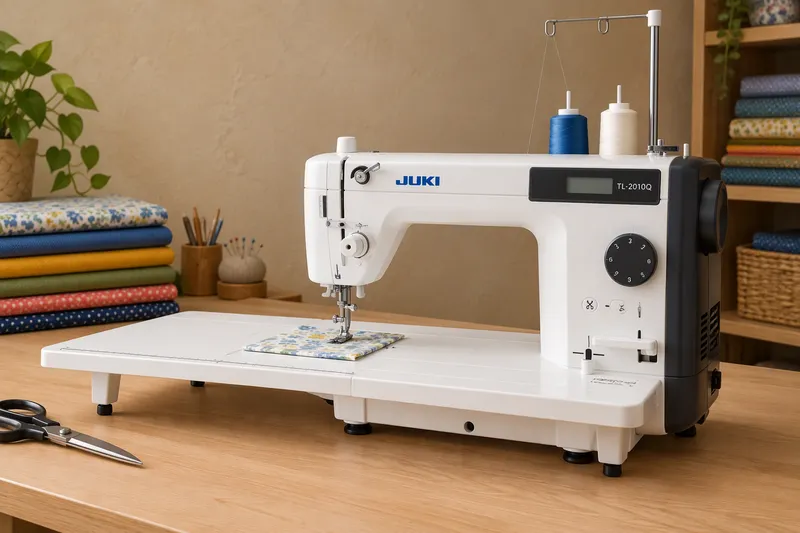
Quilters are likely to appreciate it most. The 8.5 × 6-inch arm space provides substantially more room than many conventional domestic machines, while the 23 × 13-inch auxiliary table gives large quilts more support.
The TL-2010Q is less suitable for someone looking for a single machine that can perform zigzag stitches, decorative stitches, buttonholes and embroidery. It is deliberately specialized. Its strength comes from concentrating its mechanical design on straight stitching rather than trying to do everything.
Main features
The most impressive feature of the TL-2010Q is its industrial-inspired construction. JUKI uses aluminum die-casting for the arm and bed, creating a rigid platform designed to reduce vibration while sewing. The result is a machine that feels substantially more serious than a lightweight entry-level domestic model.
Its maximum sewing speed is 1,500 stitches per minute, which is considerably faster than many ordinary home sewing machines. Importantly, you do not have to operate it at full speed. A speed-control slider allows the maximum speed to be adjusted between approximately 200 and 1,500 SPM, making the machine much easier to control when performing detailed quilting or working with challenging materials.
Another useful feature is the sub-tension unit. This helps stabilize thread delivery and is particularly useful when working with different thread types. The conventional tension system also has a clearly marked scale, allowing the user to make mechanical adjustments according to the fabric and thread combination.
JUKI has equipped the machine with an automatic thread trimmer that cuts both needle and bobbin threads. The function can be activated with the dedicated button or through the heel side of the foot controller. For quilting and long sewing sessions, this can save considerable time.
The machine also includes an automatic needle threader, LED lighting, needle-up/down control, drop feed and a knee lifter. The knee lifter can raise the presser foot as high as 12 mm, allowing bulky projects to be positioned without taking your hands away from the fabric.
Sewing performance
The TL-2010Q is at its best when you need straight stitches that are fast, consistent and accurately controlled.
Its 1,500 SPM maximum speed makes a noticeable difference on long seams. A quilter piecing numerous blocks or a sewist making curtains, bags or garments can cover considerable distances quickly. At the same time, the adjustable speed limiter means the machine can be slowed down dramatically when precision matters more than speed.
The needle-stop function is particularly useful. The TL-2010Q normally stops with the needle in the down position, and a dedicated button allows the user to move the needle up or down. Keeping the needle in the fabric is valuable when pivoting around corners or repositioning a quilt.
The stepless presser-foot pressure adjustment is another important technical advantage. Different materials compress and feed differently, so being able to adjust pressure can help prevent unwanted fabric distortion. This is especially useful when moving between lightweight garments, layered quilting cotton and heavier materials.
The feed system is designed for difficult materials as well. The supplied even-feed foot helps move multiple layers together and can be useful with materials that tend to shift or feed unevenly.
The horizontal-axis full-rotary hook and adjustable stitch length up to 6 mm complete a mechanical system that is focused on reliable straight stitching.
Quilting / heavy fabric / leather suitability
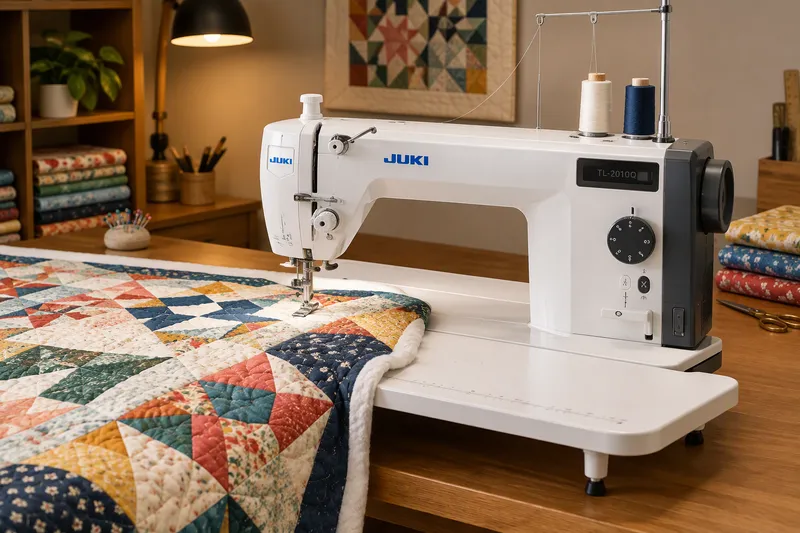
Quilting is arguably the TL-2010Q’s strongest application. The machine provides an 8.5 × 6-inch working area, while the auxiliary table expands the working surface to approximately 23 × 13 inches. This additional space is valuable when supporting a large quilt.
The feed dogs can also be lowered for free-motion quilting, and the machine includes a 1/4-inch quilting foot. The speed-control system is particularly useful here because free-motion quilting often requires much slower, carefully controlled sewing rather than maximum speed.
For heavy fabrics, the TL-2010Q is more capable than many ordinary domestic sewing machines. The rigid aluminum body, adjustable presser-foot pressure, high presser-foot lift and even-feed foot make it suitable for denim, canvas and multiple layers.
It can also be considered among sewing machines for leather work. JUKI specifically states that the even-feed foot can handle heavy materials such as leather. However, this should not be confused with an industrial leather machine. The TL-2010Q is still a domestic/semi-professional straight-stitch machine, so very thick leather assemblies are outside its intended range.
Pros and cons
Pros
- Excellent straight-stitch quality
- Maximum speed of 1,500 SPM
- Adjustable maximum sewing speed
- Large 8.5 × 6-inch arm space
- 23 × 13-inch auxiliary table
- Automatic thread trimming
- Knee lifter with up to 12 mm presser-foot lift
- Adjustable presser-foot pressure
- Aluminum die-cast arm and bed
- Drop feed for free-motion quilting
- Supplied even-feed and 1/4-inch quilting feet
- Suitable for multiple fabric layers
- Industrial-style features without requiring a full industrial setup
Cons
- Straight stitch only
- No zigzag or decorative stitches
- No built-in buttonhole capability
- Relatively heavy at 25.4 lb
- Less versatile than a conventional computerized machine
- Not a substitute for a dedicated industrial leather machine
- Requires more sewing knowledge than a basic beginner machine
Specifications
The JUKI TL-2010Q measures approximately 452 × 350 × 219 mm and weighs 11.5 kg (25.4 lb). Its arm space measures 8.5 × 6 inches, while the supplied auxiliary table measures approximately 23 × 13 inches.
The machine offers a maximum sewing speed of 1,500 SPM and a stitch-length range of 0–6 mm. It uses HA-type 130/705H needles as well as HL×5 needles, depending on the application. Other specifications include a horizontal-axis full-rotary hook, automatic needle threading, automatic thread trimming, LED lighting, drop feed, speed control, needle-down positioning and stepless presser-foot-pressure adjustment.
Comparison with alternatives
The TL-2010Q occupies a specialized position among sewing machines. Compared with a conventional computerized Brother machine, it offers dramatically fewer stitch functions, but provides a much stronger focus on straight stitching, quilting and fabric control.
The Brother PQ1600S is one of the closest alternatives in concept. Like the JUKI, it is designed specifically around straight stitching and quilting rather than decorative sewing. Both machines reach 1,500 SPM and are aimed at sewists who want more working space and control than a standard domestic machine.
Another obvious alternative is the JUKI TL-2000Qi. It follows the same industrial-inspired straight-stitch philosophy and is suitable for quilting, piecing and apparel sewing. The TL-2010Q is particularly attractive when features such as speed control, sub-tension and automatic thread trimming are priorities.
If you want a machine for quilting and demanding straight-stitch projects, the TL-2010Q is considerably more specialized than a typical Brother computerized machine. If you want decorative stitches and maximum versatility, however, a conventional computerized machine will make more sense.
FAQ
Is the JUKI TL-2010Q good for beginners?
It depends on what type of beginner you are. Someone completely new to sewing may find a basic computerized machine easier because it offers zigzag stitches, buttonholes and more automatic functions. However, a beginner who specifically wants to learn quilting or professional-style straight stitching can use the TL-2010Q successfully.
Its controls are not particularly complicated: stitch length, thread tension, presser-foot pressure and sewing speed are adjusted directly. The challenge is that the machine assumes you actually want a straight-stitch specialist.
Is the JUKI TL-2010Q good for quilting?
Yes. Quilting is one of the reasons to buy this machine. Its large arm space, auxiliary table, adjustable speed, needle-down function, drop feed, knee lifter and 1/4-inch quilting foot make it particularly well suited to piecing and free-motion quilting.
The speed-control slider is especially useful. You can limit the machine’s maximum speed when learning free-motion techniques and increase it when working on long, straightforward seams. JUKI specifically describes the TL-2010Q as a quilting and piecing machine.
Can the JUKI TL-2010Q sew leather?
Yes, within reasonable limits. JUKI specifically states that its even-feed foot can be used with heavy materials including leather. This makes the TL-2010Q more interesting for certain leather projects than many ordinary household sewing machines.
However, I would not describe it as one of the best industrial sewing machines for leather work. Thin and moderate-weight leather projects may be realistic, but very thick leather, multiple heavy layers and continuous production work are better handled by specialized industrial leather machines.
Is the JUKI TL-2010Q a heavy-duty sewing machine?
It is better described as a semi-professional straight-stitch machine with industrial-inspired construction rather than simply calling it a heavy-duty sewing machine.
Its aluminum die-cast body, high sewing speed, adjustable presser-foot pressure and even-feed foot give it strong capabilities with heavy fabrics. Nevertheless, its design is focused on precision straight stitching rather than the broad material-handling capabilities of a dedicated industrial machine.
JUKI TL-2010Q vs Brother PQ1600S: which is better?
Both are excellent choices for sewists who primarily want straight stitching and quilting. The JUKI has an 8.5 × 6-inch arm space, adjustable presser-foot pressure, speed control, automatic thread trimming and a knee lifter. The Brother is another strong quilting-oriented alternative.
The better choice depends on the features you value most. For someone who particularly appreciates JUKI’s industrial-style mechanical design and thread-trimming system, the TL-2010Q is compelling.
JUKI TL-2010Q vs JUKI TL-2000Qi: which should you choose?
The TL-2010Q and TL-2000Qi share the same basic philosophy: both are straight-stitch specialists designed for quilting, piecing and apparel work. The TL-2010Q adds features such as the sub-tension unit and maximum-speed control, making it particularly attractive for users who want greater control over sewing speed and thread handling.
If your work consists primarily of quilting and precision straight stitching, either can be a strong choice. The TL-2010Q makes more sense when its additional control features are important to your workflow.
Can the JUKI TL-2010Q replace a normal sewing machine?
For a sewist whose projects are dominated by straight stitching, absolutely. It can be an excellent primary machine for quilting, piecing, tailoring, topstitching and home décor.
But it cannot replace an all-purpose machine for every project. There is no zigzag stitch, decorative stitch library or conventional buttonhole system. This is the fundamental trade-off: JUKI has concentrated the machine’s engineering on doing one type of stitch exceptionally well rather than offering dozens of stitch options.
Is the JUKI TL-2010Q worth buying for quilting?
For a serious quilter, it can be. The large work area, high speed, adjustable speed control, automatic thread trimming, knee lifter, drop feed and dedicated quilting accessories create a very specialized tool.
Its biggest advantage is not the number of stitches but the quality of the sewing environment. If you regularly work on large quilts and want a stable machine that can sew quickly while still allowing precise low-speed control, the TL-2010Q is much more interesting than a basic domestic machine.