
Let’s see the SINGER Heavy Duty 4423
Introduction
The SINGER Heavy Duty 4423 is a mechanical sewing machine designed for home sewers who want more power and stability when working with demanding fabrics. It combines a heavy-duty metal frame with a high-performance motor, a stainless-steel bed plate, 23 built-in stitches, and a maximum sewing speed of 1,100 stitches per minute. SINGER specifically positions the 4423 for projects involving fabrics such as denim and canvas, while its adjustable presser-foot pressure also allows it to handle lighter materials.
Unlike computerized sewing machines, the 4423 uses straightforward mechanical controls. That makes it appealing to beginners who prefer simple operation as well as experienced sewers who value durability and direct control.
Who Is This Machine For?
The SINGER Heavy Duty 4423 is a good option for home sewers who want a straightforward machine capable of handling everyday projects and heavier fabrics. It can be particularly useful for people who regularly work with denim, canvas, multiple layers of fabric, home-decorating materials, and garments that require stronger seams.
Beginners can also consider the 4423 because its mechanical design is relatively easy to understand. Instead of navigating an electronic menu, you select stitches and adjust settings using physical controls. The built-in needle threader and top drop-in bobbin make some of the routine setup tasks easier.
It is also worth considering for experienced users who don’t need hundreds of stitches or computerized functions. The machine focuses more on practical sewing performance than electronic features.
However, it isn’t automatically the best choice for every sewer. If you mainly want decorative stitches, computerized convenience, embroidery features, or sophisticated quilting functions, other sewing machines may be more appropriate.
Main Features
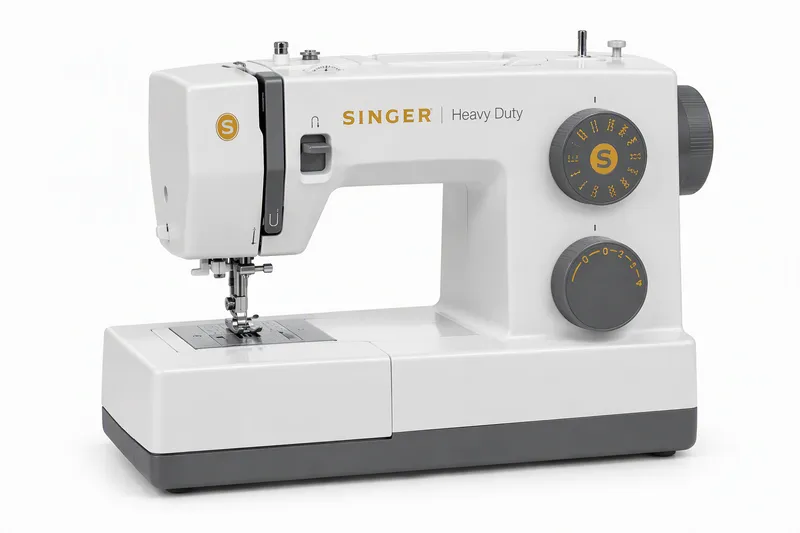
One of the main attractions of the SINGER 4423 is its combination of power and mechanical simplicity. The machine has a heavy-duty metal interior frame designed to provide stability and keep the internal mechanisms aligned during sewing. It also has a stainless-steel bed plate, which provides a smooth surface for fabric to move across.
The machine offers 23 built-in stitches, covering basic, stretch, and decorative sewing. SINGER describes these as 97 stitch applications because individual stitches can be used for different techniques. There is also a one-step buttonhole function, which simplifies the process of creating buttonholes.
The 4423 has a high-performance motor that SINGER says is 60% stronger than a standard sewing-machine motor. It can sew at speeds of up to 1,100 stitches per minute, which can be useful when completing long seams or larger projects.
Other useful features include an automatic needle threader, top drop-in bobbin, adjustable stitch length, adjustable stitch width up to 6 mm, three needle positions, adjustable presser-foot pressure, reverse sewing, and an extra-high presser-foot lifter for thicker materials.
The included accessories include a general-purpose foot, zipper foot, buttonhole foot, button-sewing foot, edge/quilting guide, needles, bobbins, and other basic tools.
Sewing Performance
The SINGER Heavy Duty 4423 is most convincing when its power is actually useful. Its combination of a rigid metal frame, strong motor, and stainless-steel bed plate gives the machine a stable feel during sewing. The extra-high presser-foot lifter is particularly useful when positioning thicker layers beneath the foot.
For everyday sewing, the machine can handle common tasks such as seams, hems, garment construction, repairs, and decorative stitching. The 23 stitches aren’t an enormous selection compared with many computerized sewing machines, but they cover many of the techniques a home sewer actually uses.
The 1,100-stitches-per-minute maximum speed is another advantage. It allows experienced users to complete straightforward seams quickly. Beginners, however, may prefer to start slowly until they become comfortable controlling the machine.
The adjustable presser-foot pressure is particularly useful because it makes the 4423 more versatile than its “heavy duty” name might suggest. SINGER states that this adjustment can help when sewing both very lightweight sheers and heavyweight fabrics.
Overall, the 4423 is best viewed as a practical workhorse rather than a feature-heavy machine. It concentrates on strong everyday performance instead of computerized convenience.
Quilting, Heavy Fabric and Leather Suitability
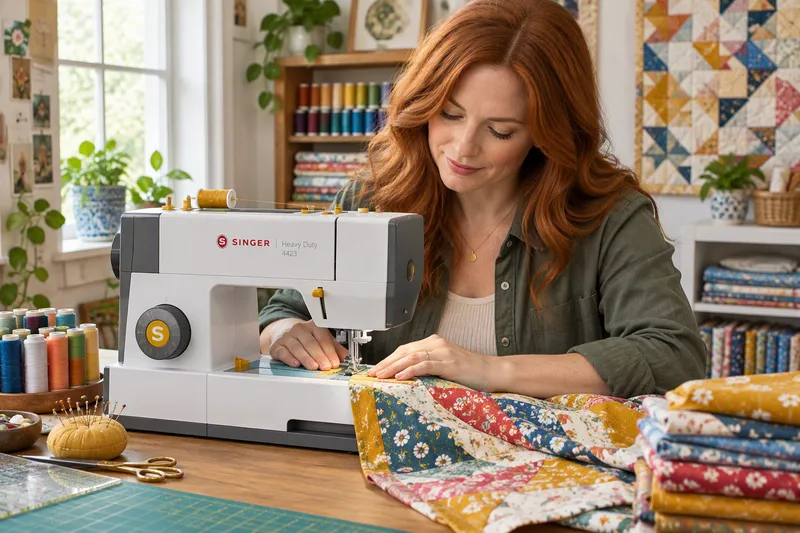
The 4423 can be a useful choice for quilting, particularly for piecing quilt blocks and sewing projects involving heavier quilting fabrics. SINGER includes an edge/quilting guide, and the machine’s 6.25-inch space from the needle to the tower provides a reasonable working area.
However, dedicated sewing machines for quilting can offer advantages such as a larger throat space, extension tables, walking feet, or more specialized quilting accessories. Therefore, the 4423 is better suited to general quilting and smaller-to-medium projects than to serious quilting production.
For heavy fabric, the machine is much more convincing. SINGER specifically describes it for denim and canvas, and the extra-high presser-foot lifter and stronger motor are useful when dealing with thicker layers.
Leather is a different matter. Although the 4423 has considerably more power than many basic household machines, it is not an industrial leather machine. It may be suitable for some lighter leather applications with the appropriate needle, thread, and technique, but regular sewing of thick leather is better handled by specialized machines designed for that purpose.
Pros and Cons
Pros
- Strong mechanical design
- Heavy-duty metal interior frame
- Powerful motor for thicker fabrics
- Maximum speed of 1,100 stitches per minute
- 23 built-in stitches
- 97 stitch applications
- One-step buttonhole
- Automatic needle threader
- Adjustable presser-foot pressure
- Extra-high presser-foot lifter
- Free arm for cuffs and sleeves
- Useful quilting guide included
- Suitable for denim and canvas
- Straightforward controls
Cons
- Not a computerized machine
- Fewer stitch choices than many computerized models
- Not designed specifically for embroidery
- Limited compared with specialized quilting machines
- Heavy leather work is outside its main purpose
- High maximum speed can take practice for beginners
- Some advanced users may want more specialized accessories
Specifications
The SINGER Heavy Duty 4423 has 23 built-in stitches and 97 stitch applications, including a one-step buttonhole. Its maximum sewing speed is 1,100 stitches per minute, with adjustable stitch width up to 6 mm. It has a metal interior frame, stainless-steel bed plate, free arm, automatic needle threader, top drop-in bobbin, and adjustable presser-foot pressure.
The machine measures approximately 15.5 × 6.25 × 12 inches and weighs approximately 14.6 pounds. The sewing space from the needle to the machine tower is 6.25 inches.
It uses Class 15 transparent bobbins, and SINGER supplies a soft machine cover along with the included accessories.
Comparison With Alternatives
The SINGER Heavy Duty 4423 makes the most sense when you value power and mechanical simplicity. Compared with the Brother CS5055, for example, it has a very different approach. The Brother is a computerized machine with a larger selection of built-in stitches and a more beginner-oriented electronic interface, while the 4423 emphasizes mechanical controls and heavier-fabric capability.
The Janome HD3000 is another natural alternative. Like the 4423, it is a mechanical heavy-duty machine aimed at users who want a sturdy everyday sewing machine. The choice between them may come down to preferred controls, included accessories, price, and the type of fabrics you sew most often.
For quilters, the JUKI TL-2010Q offers another direction. It is focused much more heavily on straight-stitch quilting and larger quilting projects, whereas the 4423 provides greater stitch variety for general-purpose sewing.
For users who don’t need computerized functions but want a versatile machine capable of working with heavier materials, the 4423 remains one of the more interesting heavy-duty sewing machines to consider.
FAQ
Is the SINGER Heavy Duty 4423 good for beginners?
Yes. Its mechanical controls are relatively straightforward, and features such as the automatic needle threader and top drop-in bobbin simplify setup. Beginners should still spend time learning thread tension, needle selection, stitch settings, and speed control.
Is the SINGER 4423 actually a heavy-duty sewing machine?
Yes, it is designed as a heavy-duty household machine. SINGER states that it has a heavy-duty metal interior frame and a motor that is 60% stronger than a standard sewing-machine motor.
Can the SINGER 4423 sew denim?
Yes. Denim is one of the fabrics SINGER specifically identifies for the 4423. Its stronger motor, extra-high presser-foot lifter, and heavy-duty construction make it better suited to thick fabrics than many basic household machines.
Is the SINGER 4423 good for quilting?
It can be a good general-purpose quilting machine, particularly for piecing and smaller projects. It includes an edge/quilting guide and has a 6.25-inch sewing space. However, dedicated sewing machines for quilting can provide more specialized features and workspace.
Is the SINGER 4423 a computerized sewing machine?
No. The 4423 is a mechanical sewing machine. If you specifically want the convenience of computerized stitch selection, an electronic model such as the Brother CS5055 may be a better fit.
Can the SINGER 4423 sew leather?
It is not a dedicated leather machine. The 4423 has useful power for heavy household fabrics, but thick leather can place very different demands on a sewing machine. For regular leather work, a specialized machine is a safer choice.
How fast can the SINGER 4423 sew?
Its maximum sewing speed is 1,100 stitches per minute. This is useful for experienced sewers working on long seams, although beginners may want to start at a slower, more controlled pace.
Does the SINGER 4423 have an automatic needle threader?
Yes. The machine has a built-in needle threader designed to make threading the needle easier.
Is the SINGER 4423 better than computerized sewing machines?
Not necessarily. They are designed around different priorities. The 4423 is a good choice if you prioritize mechanical simplicity, speed, and heavier fabrics. Computerized sewing machines generally offer easier stitch selection, more stitch variety, and additional electronic functions. Your choice should depend on the type of sewing you actually do.
Who should buy the SINGER Heavy Duty 4423?
The 4423 is particularly appealing to home sewers who want a straightforward mechanical machine for everyday sewing, denim, canvas, clothing, alterations, crafts, and some quilting. It is less suitable for someone primarily looking for embroidery, advanced computerized functions, or professional leather sewing.